
Bologna prepares for spring 2027 tram (re-)launch
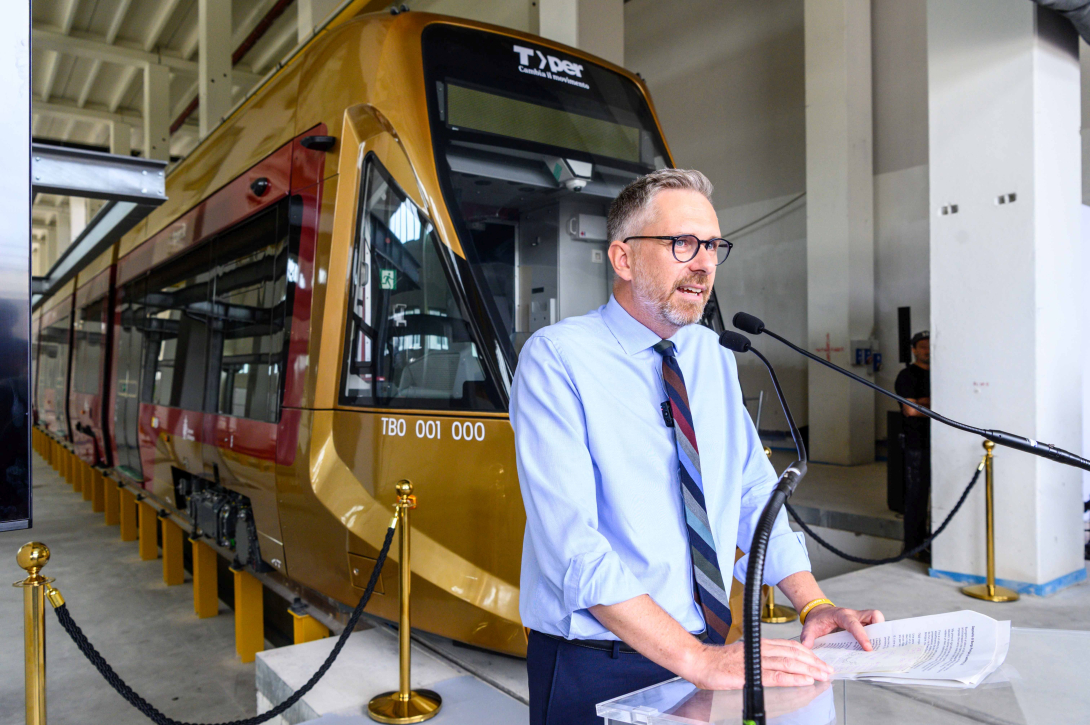
The Italian city of Bologna plans to have its first passenger tram services in around 70 years operating in spring 2027, after it took delivery of the first of the battery-powered vehicles that will operate on its new tram network.
The tram project is part of a broader ambition to make the city’s public transport system more sustainable.
The northern Italian city received the first of 35 battery-powered URBOS trams manufactured by Spanish company CAF in September and is now carrying out on-the-ground testing in evenings and at night time, said Luca Bellinato, who has been senior manager at the mobility systems unit for Bologna, since 2021.

Luca Bellinato, Senior Manager, Mobility Systems, Bologna
“We also have a specific target of reducing car journeys by roughly 300,000 per day,” he said. “The tram network is one of the measures intended to help achieve that.”
The project marks a return to the tram for Bologna, which had an extensive tram network–of around 80km–in place up until the 1950s, when buses, then a quicker, higher-capacity alternative, started to replace the trams.
Now, things have come full circle. “The new trams have greater capacity than buses and can be faster because they have dedicated lanes, while buses are caught in the traffic among cars,” Bellinato said.
Most of the new network is mapped on top of the old, except when some narrow corners in the city centre’s medieval streets call for a reroute.
The four-line tram project is part of Bologna’s Sustainable Urban Mobility Plan, approved in 2019, and the first line, the red line, which traces the historical tram route, is complete. Now the first of the vehicles has arrived, tests are underway, starting from the depot and heading towards the city centre–the 15km-long red line runs west to east/north-east, passing through Bologna’s medieval city centre.
At the tram depot/bus station on the west of the city, passengers coming in by bus from neighbouring municipalities, will be able to switch to the tram, with the bus route terminating at the interchange.
“Having the tram pass through the city centre was a deliberate choice,” Bellinato said. City authorities wanted to connect the outskirts with the centre, rather than create a peripheral line. “That made the building work very difficult, there was a great deal of construction and disruption, but the aim was to make it possible for people living in outlying neighbourhoods to leave their cars at home, take the tram into Bologna and go not only to work, but also to a restaurant or an exhibition.”
The city selected the URBOS battery-powered trams so that they could run without using overhead wires through the medieval city centre before reconnecting to the wires to recharge once outside the central zone.
The tram project is a key part of a broader revamp of Bologna’s urban environment and public space, which includes uncovering the Reno canal, which had been built over to make space for car parking in the 1950s, pedestrianising part of the main shopping street via Independenza, and imposing a 30km speed limit everywhere in the city, except for the main road network.
It also forms a key part, alongside hydrogen, methane and electric buses, of its ambition of a fully zero-emission local public transport fleet by 2030.
“The tram is not simply a mode of transport,” he added. “It is also a project to transform urban space and improve the quality of the urban environment, not only by developing transport infrastructure but also by acting as a catalyst for urban redevelopment along the entire route.”
Main image: City of Bologna