
The gaps we need to close in our mobility strategies
By Rikesh Shah, Chair of the Transport Innovation Alliance
In May, as Chair of the Transport Innovation Alliance, it was a genuine pleasure to lead our Leadership Forum in Barcelona — bringing together 20 cities from across Europe and some of the world’s leading mobility experts for two days of open, frank discussion. A particular thanks to Manuel Valdés and the team at ATM Àrea de Barcelona for being such generous and engaged hosts. What made Barcelona particularly striking was how closely it echoed what I heard at our North American session in Detroit last month — the same questions, the same tensions, the same urgency, just in a different context. These are not local challenges; they are global ones.
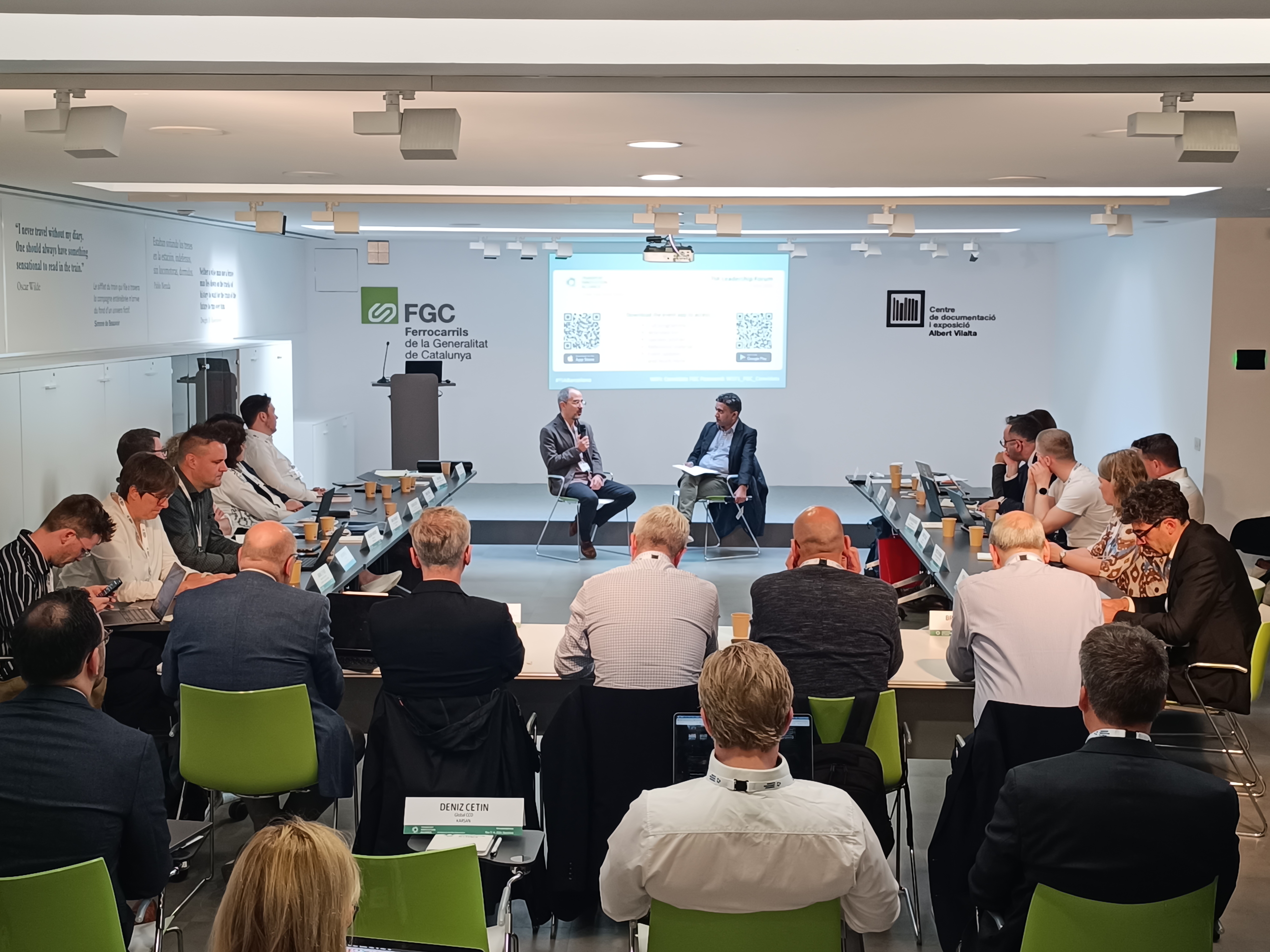
Rikesh Shah in conversation with Manuel Valdés, CEO of ATM Barcelona, at the TIA Leadership Forum
The agenda was deliberately broad reflecting the myriad challenges we see in our cities everyday: cycling networks and modal shift, fleet decarbonisation, autonomous vehicles across shared, bus, and private car applications, micromobility integration, public bus efficiency, and a site visit to the Glòries interchange. Yet three themes kept resurfacing across every session, every roundtable, every case study — Net Zero, Vision Zero, and the importance of data in understanding how to reach our mobility goals. These themes pose overlapping challenges that cities cannot solve in isolation.
On Net Zero, regional and city joint strategies will remain aspirational documents unless they grapple honestly with how change happens — not just what targets to set — and look beyond the city boundary. There was an honest acknowledgement that the car will co-exist with other modes for the foreseeable future, but its footprint must shrink while investment in alternatives grows.
A related area was EV infrastructure: we are deploying heavily without the data to know whether it is going in the right places. Closing the communication gap between transport agencies, stakeholders, and industry around what Net Zero actually requires — and what interventions work — demands that different perspectives are properly heard. It is something I saw first-hand at Transport for London, navigating boroughs, suppliers, and citizens who might have different motivations so communication and relationships are key.
On Vision Zero, the consistent thread was a systems approach — safety cannot be designed in isolation from the wider urban environment. Autonomous vehicles (buses, private and shared taxis) came up several times as a case in point: the potential to reduce human error and save lives is real, but only if the risks are properly understood and mitigations rigorously managed and we saw strong arguments of how safe AVs can be. The technology’s promise cannot be allowed to run ahead of the governance. For public buses in particular, the conversation around autonomy cannot be separated from total cost of ownership — the case for deployment has to stack up financially as well as operationally, and cities need robust frameworks to evaluate that.
Placemaking is equally central to this: streets built well for people are inherently safer, more accessible, and more likely to shift travel behaviour. Living in Watford and working in London, I have seen an excellent effort for better placemaking and more space for vulnerable road users. You notice the difference straight away. Road safety is not just a traffic engineering problem; it is a question of what kind of places we want to create. And that ambition cannot rest with cities alone — regional and local plans need to reflect it jointly, because the journeys people make do not stop at administrative boundaries.
On data — the connective tissue running through both — it must serve city goals and not become an end in itself. Cities consistently tracking modal shift are seeing results; those that are not, are flying blind. And data without narrative is just numbers on a slide.
The gaps are clear. That is why the Transport Innovation Alliance is now taking three working groups forward — on Net Zero, Vision Zero, and data and policy — to turn these conversations into structured, collaborative action. We are inviting cities to express their interest in joining. The work starts here.